



Best Cartier Santos Replica Watches
Among all Cartier collections, Santos is the one that truly “dared to be first.” It is neither as restrained and square as the Tank, nor as rounded and floating as the Ballon Bleu. Instead, it is a square watch born in 1904, and the first modern timepiece in watchmaking history designed specifically to be worn on the wrist.
At the time, Brazilian aviation pioneer Alberto Santos-Dumont found it inconvenient to take a pocket watch out while flying, since both hands were occupied. He turned to his friend Louis Cartier for a solution. In 1904, that solution arrived: a small timepiece attached to a leather strap that could be fastened to the wrist. In 1911, the Santos officially entered mass production, and the world was introduced to the concept of “time on the wrist.” NTVWATCH selects high-quality Santos replica versions through factory-direct channels, bringing this “square classic born from the sky” to your hand in a more practical way.
Santos
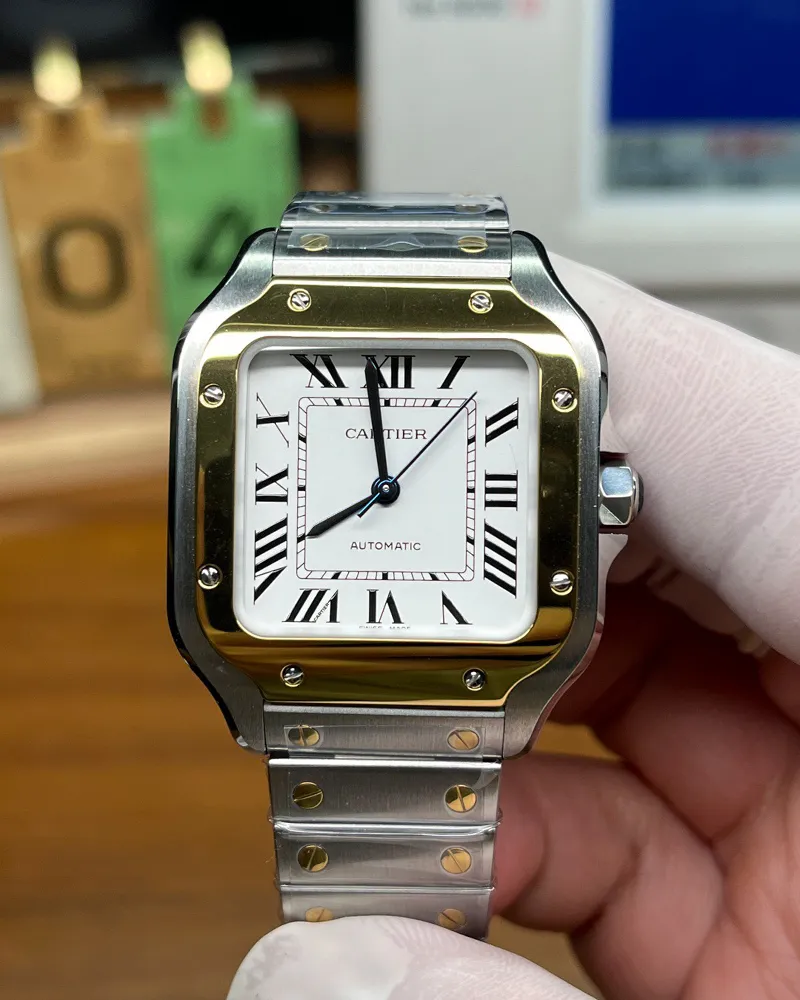
Cartier Santos W2SA0007 Steel/Yellow Gold Two Tone Replica Watch
In stock
Original price was: $1,080.00.$780.00Current price is: $780.00.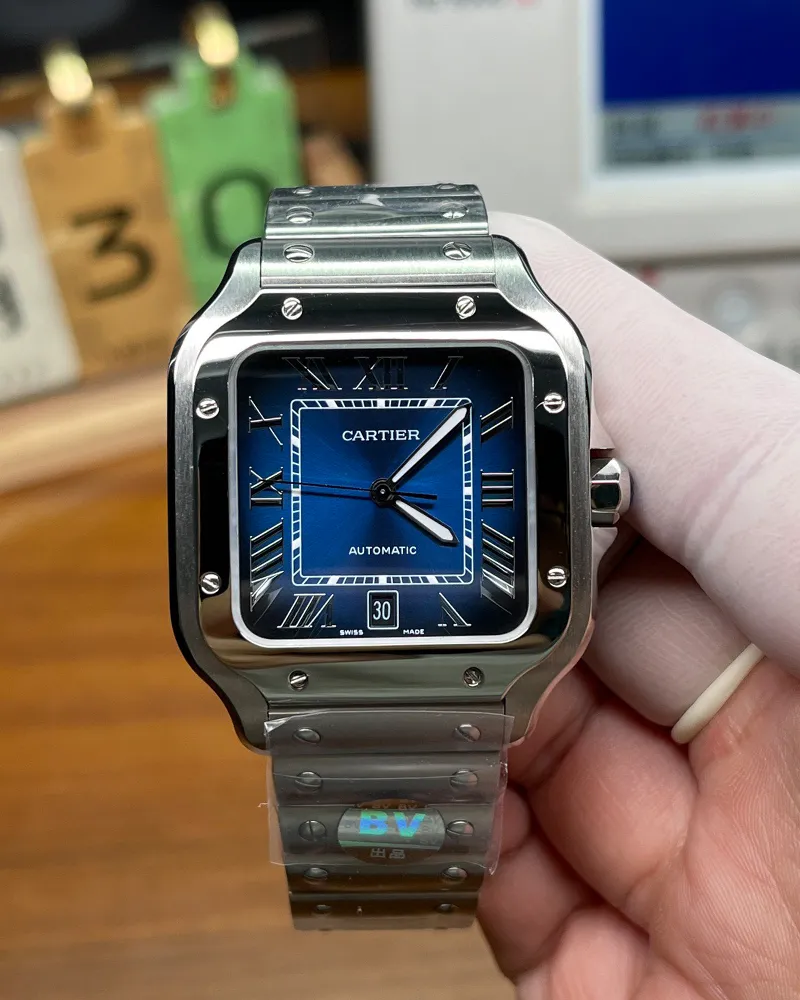
Cartier Santos WSSA0030 Large Blue dial Replica Watch
In stock
Original price was: $1,080.00.$780.00Current price is: $780.00.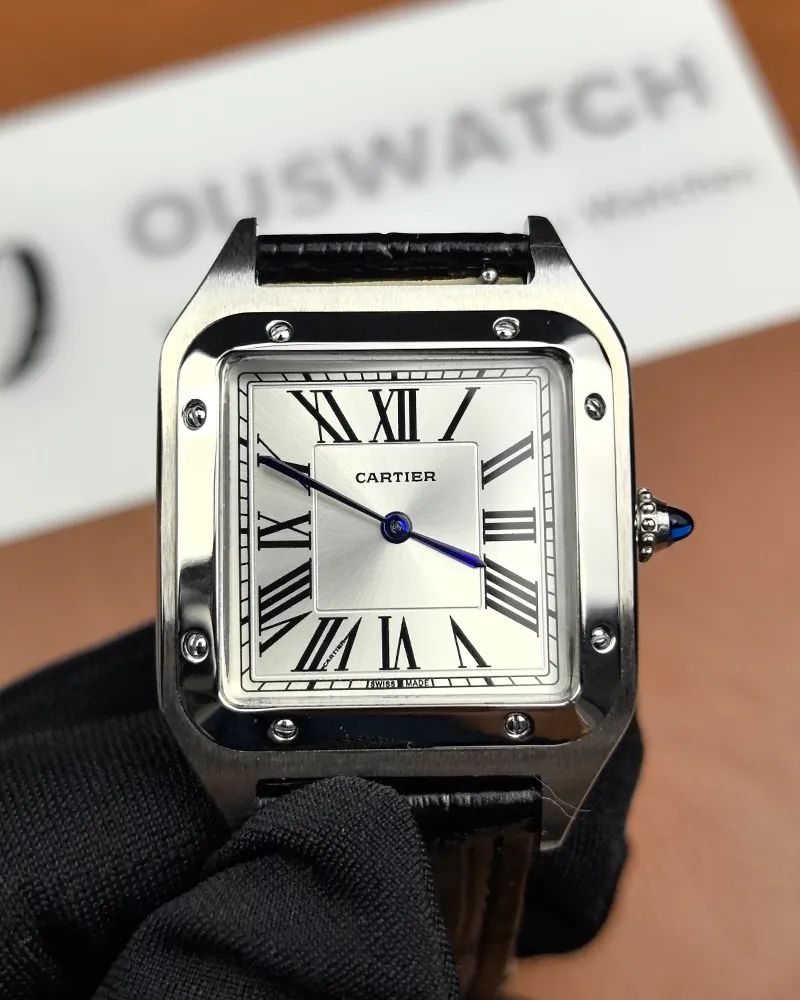
Cartier Wssa0023 Santos Dumont Small Sapphire Crocodile Leather Watch Strap Replica Watch
In stock
Original price was: $660.00.$460.00Current price is: $460.00.Instant Recognition: Square Case, Screw-Set Bezel, and Curved Lugs
The reason Santos has remained timeless for more than 120 years lies in a design language that still feels relevant today:
Rounded square case: In the early 20th century, when round cases dominated the market, Santos stood out with its square silhouette. Its shape was inspired by the four corners of the Eiffel Tower — a fitting detail, since Santos-Dumont’s famous 1901 flight around the tower was already embedded in the spirit of this watch. Replica versions faithfully reproduce the original square proportions and softened case edges.
Exposed screws: The eight symmetrical screws on the bezel are another signature Santos element. In 1978, Cartier intentionally made the structural screws visible, turning function into decoration and giving the watch its now-iconic industrial character. Replica versions closely match the original screw placement and finishing.
Integrated curved lugs: The lugs flow seamlessly from the case and curve naturally downward, replacing the separate wire lugs commonly seen in early watches. This curved profile follows the wrist more closely, allowing a square case to sit comfortably and slide neatly under a cuff. Replica versions mirror the original lug curvature as closely as possible.
Silvered guilloché dial: The silver opaline dial has a refined pearlescent texture, with delicate radiating patterns that spread outward under changing light. Large Roman numerals are arranged along the square layout, while a railway minute track frames the outer edge for clear readability.
Blued sword hands and heptagonal crown: Cartier’s signature blued sword-shaped hands remain an essential part of the Santos design. The seven-sided crown is set with a faceted blue synthetic spinel on stainless steel models, offering a smooth, refined shine without feeling sharp.
100-meter water resistance and quick-change straps: Modern Santos models are equipped with 100 meters of water resistance, making them suitable for everything from daily handwashing to swimming. The QuickSwitch system allows easy changes between steel bracelets, leather straps, and rubber straps without tools. Replica versions also recreate these two practical features.
Who Is It For? Three Typical Scenarios
Santos is best suited to people who appreciate geometric lines and the beauty of industrial design.
For history and design lovers: If you want to wear a watch that truly changed the history of watchmaking, Santos is an ideal choice. More than most round watches, it carries a deeper story — one of flight, the Eiffel Tower, and pioneering aviators.
For both business and casual wear: The square case gives it strong visual identity, while 100-meter water resistance makes it durable enough for daily life. The quick-change strap system lets it move effortlessly from the office to weekend travel. A steel bracelet feels clean and confident, leather adds elegance, and rubber brings a more relaxed tone.
For those who prefer industrial aesthetics and stronger lines: Exposed screws, squared edges, and curved lugs all express the idea that “structure itself is decoration.” It feels more powerful than the Tank and sharper than the Ballon Bleu.
How to Choose: Size, Material, and Strap
The main logic behind choosing a Santos comes down to size and strap style. The original Santos family is divided into several main size categories, and the replica market generally follows the same pattern.
1. Size — From Slim Quartz to Automatic Mechanical
Small size (Santos-Dumont style): Approximately 38mm × 27.5mm, with a slim thickness of just 7.3mm. Powered by a long-life quartz movement and paired with a leather strap, usually in blue or black alligator style. This is one of the thinnest Santos options and among the closest in spirit to the original aviation-era design. It suits slimmer wrists and those who prefer a vintage leather-strap look. Reference genuine model: WSSA0023.
Medium automatic (35mm route): Around 35mm, 8.83mm thick, with an automatic movement, 100 meters of water resistance, and a quick-change strap system. This is the hottest size in the replica market — easy to wear, suitable for both men and women, and ideal for daily use. Reference model: WSSA0029.
Large automatic (39.8mm route): Around 39.8mm, 9.38mm thick, with an automatic movement and a fuller overall presence. Best suited to wrists measuring 17cm or above, or for wearers who prefer a stronger dial presence. Reference model: WSSA0030.
Oversized chronograph (47.5mm route): About 12.5mm thick, with an automatic chronograph movement, date display, and small seconds. Best for collectors who want more complicated functions, have larger wrists, and do not mind extra thickness.
Ultra-thin historical style (43.5mm route): Only 7.3mm thick, with a distinctly vintage character. A strong option for dress wear and for those who prefer an extremely slim profile.
Quick size recommendation: For daily wear, choose the 35mm or 39.8mm automatic versions. If you prefer a slim vintage leather-strap style, look at the small quartz route. If you want chronograph functions or a larger, bolder profile, consider the 47.5mm version.
2. Materials and Dial Options
Stainless steel: The most classic Santos look. Silver guilloché dials are the most traditional, while blue or black sunburst dials feel younger and more modern. Stainless steel is the mainstream choice in the replica market.
Two-tone (steel + gold): Gold accents on the bezel or center bracelet links create a more vintage-luxury appearance.
Full steel with ADLC coating: A black-coated bezel gives the watch a more modern, sporty edge.
Diamond-set versions: Mostly concentrated in smaller sizes, with a more jewelry-oriented feel.
3. Which Strap Should You Choose?
Steel bracelet: The most complete Santos form. The bracelet links are finely finished, and the folding clasp usually includes a micro-adjustment system. If you want the most authentic integrated look, choose steel.
Alligator leather strap: Black or deep blue are the safest choices. A tapered leather strap makes the square case stand out more clearly, turning the case itself into the visual center.
Rubber strap: Available on some modern versions, offering a stronger sport feel and better suitability for summer or waterside wear.
Core decision: If you want the most complete expression of the original design, choose a steel bracelet with the 35mm or 39.8mm automatic models. If you want to highlight the square case lines and create a lighter, more elegant feel, go for a leather strap in a small or medium size. If versatility matters most, prioritize versions that follow the quick-change strap system route.
Why Santos Became the “Starting Point of the Square Watch”
In 1904, Louis Cartier created a wrist-worn timepiece for his aviator friend. It was not the first watch in the world — pocket watches had existed long before — but it was the first timepiece clearly designed to be worn on the wrist for reading time in a modern sense. When it entered commercial production in 1911, the Santos introduced a square case, exposed screws, and integrated curved lugs — features that would later be borrowed again and again by other watch designs.