



Best Cartier Baignoire Replica Watches
Among all Cartier collections, the Baignoire is something truly distinctive. It is not as angular as the Santos, nor as square and restrained as the Tank. Instead, it is a purely oval-shaped watch—rounded, soft, and free of any sharp edges. Its name means “bathtub” in French, because its oval outline closely resembles a delicate little bathtub. Its design origins are often traced back to 1912. It was further shaped in 1958 in the form of the Ovale cintré, and officially received the name Baignoire in 1973. Unlike any round watch, its oval case flows naturally along the line of the arm. On the wrist, it does not feel “attached” but rather “blended in”—a wearing philosophy that is almost jewelry-like. NTVWATCH carefully selects Baignoire replica versions through factory-direct channels, hoping to place this pure expression of the oval silhouette into your hands in a more accessible way.
Baignoire
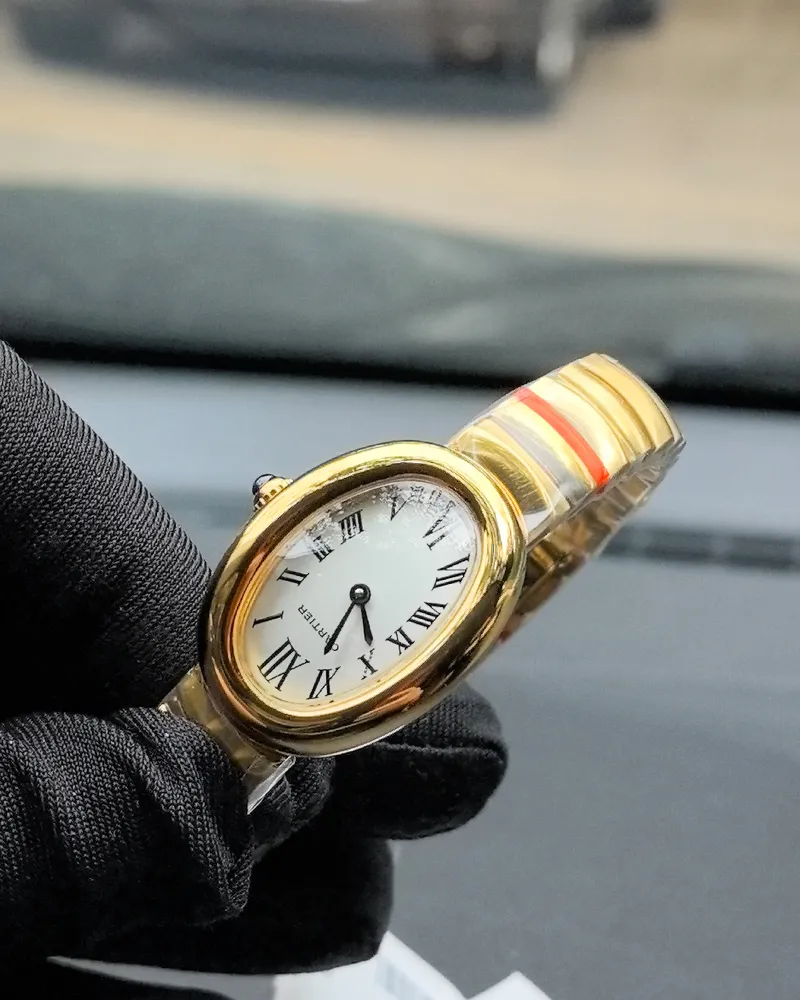
Cartier Baignoire Small Model Sapphire Yellow Gold Women’s Replica Watch
In stock
Original price was: $690.00.$490.00Current price is: $490.00.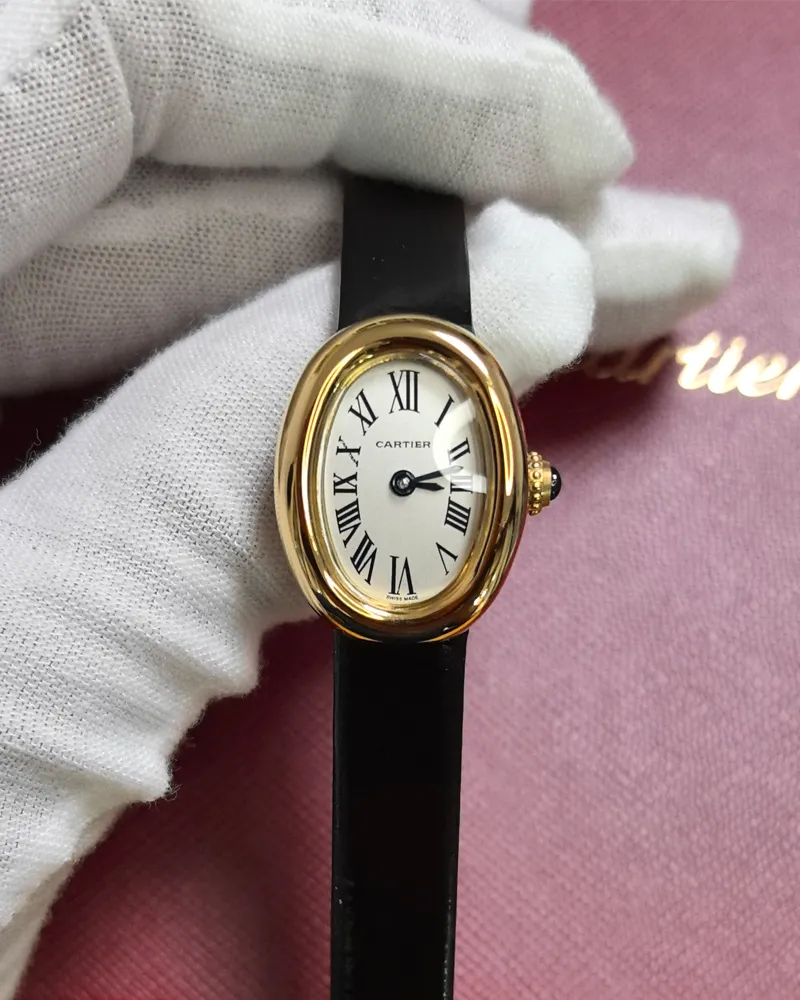
Cartier Baignoire Wgba0017 Small Model Sapphire Yellow Gold Women’s Replica Watch
In stock
Original price was: $650.00.$450.00Current price is: $450.00.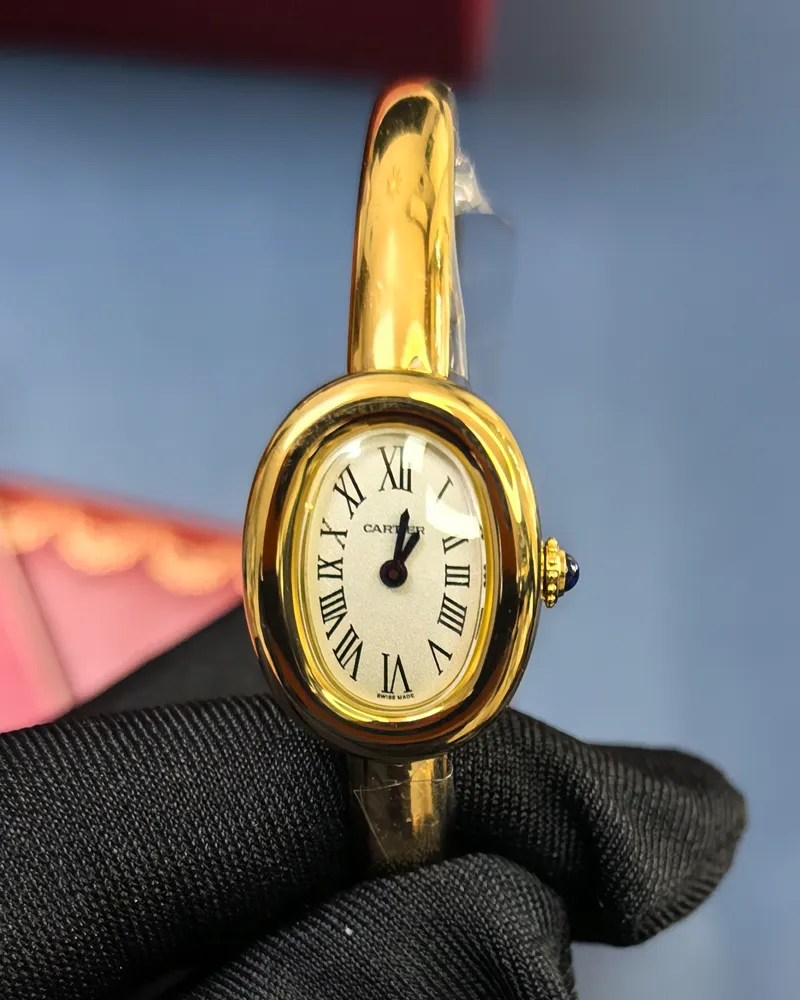
Cartier Baignoire Wgba0019 White Dial Gold Bracelet Women’s Replica Watch
In stock
Original price was: $690.00.$490.00Current price is: $490.00.Instant Recognition: Oval Silhouette, Roman Numerals, and Blue Sword Hands
The Baignoire stands out because its design language is unlike that of any other Cartier family member:
Oval case shape:
This is the soul of the Baignoire. The oval case is not simply stretched at random, but shaped through carefully refined proportions—deeper than it is wide, full and rounded at both ends, and naturally narrowing at the sides. The case is slightly curved to follow the contour of the wrist, what Cartier refers to as a curved profile. Replica versions also recreate this form, with the oval ratio and curvature closely reflecting the original.
Gold bezel encircling the oval:
The smooth, generous gold bezel follows the edge of the oval closely, gently framing the dial within. Like a fine ribbon, it naturally connects the dial and the case. Replica versions likewise reproduce this encircling gold bezel structure, with edge curves consistent with the original.
Roman numeral markers:
All the numerals on the Baignoire are arranged along the oval contour. XII and VI sit at the ends of the long axis, while III and IX are positioned along the shorter sides, closer together than on a round dial. This stretched arrangement along the oval shape is both elegant and distinctive. On some models, Cartier’s secret signature is hidden within one of the Roman numeral markers. Replica versions follow the original proportions and placement of the numerals.
Blue sword-shaped hands:
The blued sword-shaped hands are one of Cartier’s classic visual signatures, and they remain perfectly at home on the Baignoire. There are only two hands for the hours and minutes—clean, precise, and with no seconds hand. Less is more, and that is also why the Baignoire has always resisted complex functions.
Beaded crown with blue sapphire cabochon:
The beaded crown is set with a rounded blue sapphire cabochon, while some versions feature a diamond instead. With no unnecessary angles, it has a warm and refined glow. This is one of the soul details of Cartier’s jewelry watches, and replica versions also recreate it with a domed blue sapphire-style cabochon.
30 meters of daily water resistance and quartz / manual-winding movements:
Most Baignoire models offer 30 meters of water resistance, enough for daily commuting and hand washing. Replica versions generally follow this practical standard and also mirror the original movement logic—quartz versions emphasize accuracy and low maintenance, while manual-winding versions preserve a purer mechanical experience. Both types are represented in the replica market.
Who Is It For? Three Typical Scenarios
The Baignoire feels more like the watch made for people who prefer to express themselves through lines rather than color.
Women who pursue pure design aesthetics:
If you have already owned a more conventional round watch and are now looking for something with more design character and less conformity—or simply want to add a bit of Parisian charm to each gesture—the Baignoire is hard to overlook. Its oval outline means it is unlikely to look like anyone else’s watch.
A jewelry watch for daily commuting and social occasions:
The Baignoire’s compact size and smooth bezel make it feel more like a jewel on the wrist than any steel sports watch. Paired with a white shirt and black blazer, it becomes a restrained yet eye-catching detail. Worn with a dress or a semi-formal evening look, it never feels overpowering.
For those who express individuality with subtlety:
The Baignoire never relies on large dimensions or complicated functions to attract attention. Its oval outline stands out at social distance without ever feeling intentionally loud. Those who notice it—and understand it—are often the same people who have an eye for line and proportion. It is a wearing preference far more about pleasing oneself than pleasing others.
How to Choose: Size, Material, Dial, and Strap
The sizing logic of the Baignoire deserves its own explanation. Its “size” is defined by both length and width rather than by a single round diameter, so two ovals can create completely different visual impressions.
1. Size — The Wearing Differences of the Oval Silhouette
The Baignoire family follows a sizing logic closer to jewelry grading. The original collection mainly follows three routes:
Small model:
Approximately 31.4mm × 23.1mm, with a thickness of around 6.9mm. This is the most classic Baignoire size. The oval proportions are full and rounded, and on a slim wrist it feels neither too large nor too subtle. Its daily presence is highly balanced, and it is also one of the most frequently requested size routes in the replica market.
Mini model:
Approximately 24.6mm × 18.7mm, with a thickness of around 7.2mm. Cartier reintroduced the mini version in 2023. The case feels like a delicate gold ornament, and when paired with a bracelet it comes even closer to the concept of a jewelry watch. For those who love an ultra-small look or want to layer their watch like an accessory, the mini route deserves priority.
Allongée elongated model:
Usually over 47mm in length, around 21mm in width, and about 8mm thick. This is the elongated evolution of the Baignoire that emerged in the 1960s during the Swinging London era. The two ends of the oval are stretched further, creating a slimmer and more elongated look that pairs especially well with formal wear.
Simple daily-wear logic:
The adaptability of an oval silhouette depends heavily on wrist width.
Prefer something more striking or more dress-oriented → choose the Allongée elongated model.
Have a medium wrist and do not want the oval line stretched further → choose the small model.
Have a slim wrist or want something that feels more like wrist jewelry → choose the mini model.
2. Materials — A Full Look at Gold Tones
The original material logic of the Baignoire overlaps strongly with the replica market:
Yellow gold:
The most classic Baignoire face. The glow of yellow gold works especially well with the rounded elegance of the oval silhouette, and it has long been one of the most familiar material choices in the history of the Baignoire.
Rose gold:
Adds a warmer tone than yellow gold, especially on warmer skin tones, where it creates a softer visual transition.
White gold:
More restrained and cool-toned. When paired with diamonds, it comes closer to the optical logic of high jewelry.
Stainless steel:
Beyond precious metals, the Baignoire has also appeared in a limited number of steel versions, which lean more toward daily commuting and minimalist aesthetics.
Diamond-set versions:
Diamond-set bezels or fully gem-set dials move the Baignoire from the category of watch into the realm of jewelry. There are equivalent versions in the replica market as well, though special attention should be paid to the arrangement and density of the stones.
Simple material advice:
Choose yellow gold for classic vintage charm.
Choose rose gold for warmth and softness.
Choose stainless steel for a more budget-friendly daily option.
Choose diamond-set versions for a more jewelry-driven look.
3. Dial Colors — The Most Overlooked Difference in the Baignoire
The dial options may seem limited at first glance, but the differences between them are quite meaningful:
Silver guilloché dial:
A white or silver guilloché dial with black Roman numerals is the most classic face, with a texture as delicate as silk.
Mother-of-pearl dial:
The natural glow of mother-of-pearl adds a living, shifting quality to the oval, allowing the dial to change with the light.
Black lacquer dial:
Monochrome lacquer dials are a more recent experiment. Black is low-risk and flattering on many skin tones, while some limited versions have used brighter solid lacquer colors such as red or brown.
Full diamond-set dial:
A dial fully paved with diamonds is ideal for those who prioritize jewelry presence above all else.
Simple dial advice:
Choose the silver guilloché dial if you want the safest classic choice.
Choose mother-of-pearl if you want subtle light and texture.
Choose a solid lacquer dial if you want something more individual.
4. How to Choose Between Strap and Bracelet
Leather strap:
A black or dark brown alligator strap is the safest pairing. Baignoire straps tend to be narrower than those of conventional round watches, offering a closer and more delicate fit.
Gold bracelet:
Beginning in 2023, Cartier began pairing the Baignoire with gold bracelet forms, turning the watch and bracelet into one unified piece—both watch and jewel. In social settings, bracelet versions are far more recognizable than conventional leather-strap models, making them ideal as statement accessories.
Gold link bracelet:
Some historical Baignoire models use gold link bracelets rather than solid bangle-style bracelets. The construction between each link determines the comfort on the wrist. When choosing replica bracelet versions, it is worth paying close attention to the direction of satin brushing and the cleanliness of the polished transitions across each link.
Core decision:
For daily commuting and a classic look → small or mini model + black alligator strap.
For stronger recognition in social settings → gold bracelet version.
For a wider wrist or a preference for a more decorative elongated oval → Allongée model + leather strap.
Choosing a Baignoire replica is, at its core, about choosing the proportion and character of the oval silhouette. The combination of precious-metal glow and curved crystal creates an oval reflective surface that is often the first detail the eye catches when the wrist moves.
Why Has the Baignoire Become the Representative Oval Watch?
Its design origins are often traced back to 1912. At a time when nearly every watchmaker was pursuing the round watch, Cartier chose the oval—a closed curve with almost no sharp angles. The Baignoire oval is neither a simple stretched circle nor a casual sketch. It is deeper than it is wide, full at both ends, narrowing at the sides, with a curved crystal that bends gently downward to follow the wrist. The line appears soft, but is in fact extremely difficult to control—too wide and it becomes bulky, too narrow and it turns stiff. The Ovale cintré of 1958 marked its first appearance in the form of a curved oval, and in 1973 it officially received the name Baignoire.
Cartier succeeded. It turned an oval watch that resembles a little bathtub into a true symbol of French elegance.
The replica version of the Baignoire exists so that more people can experience, at a lower cost, that century-old design instinct—how an oval outline later named Baignoire could, through the passage of time, become one of the clearest lessons in line-based aesthetics.